
Jackson County Arrest Warrants Explained
An arrest warrant gives law enforcement the power to take a named or described person into custody. Under Alabama Rule of Criminal Procedure 2.4, a judge or magistrate reviews the complaint, the supporting evidence, and any sworn witnesses. The official must be reasonably satisfied that an offense occurred and that probable cause ties the accused person to it. Rule 3.1 then calls for an arrest warrant or, in fitting cases, a summons. Keep the roles straight when you check a Jackson County arrest warrant. The magistrate is the neutral decision-maker. The Circuit Clerk keeps the records and handles court business but never decides probable cause on his own. The sheriff receives issued process and serves it. Those separate jobs matter when you ask how a Jackson County warrant can be addressed.
Jackson County Arrest Warrant Review
The local route turns on the alleged offense. For a Jackson County misdemeanor outside municipal limits, the official warrant magistrate instructions start with a police or sheriff incident report. The complainant carries that report through the Sheriff's Office and Circuit Clerk route, writes a deposition in their own words, and swears to it before the magistrate. Questions may follow. The magistrate then weighs whether probable cause exists.
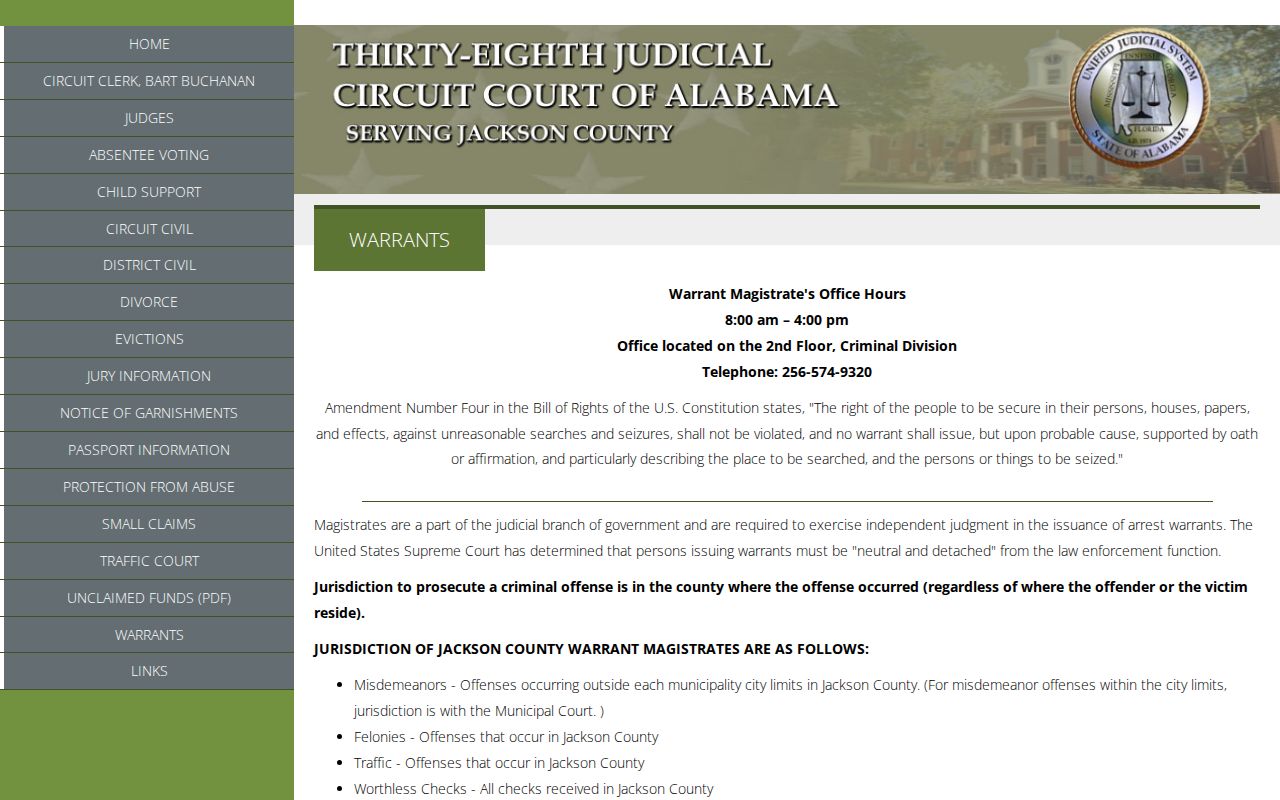
A felony usually starts with a law-enforcement investigation. An investigator opens the warrant process rather than sending a private complainant through the misdemeanor deposition steps. A misdemeanor inside a municipality routes to that municipal court instead. None of these application paths doubles as a public self-search portal.
Note: A complaint starts review, but only an authorized judge or magistrate decides whether Jackson County arrest process should issue.
Inside a Jackson County Arrest Warrant
Alabama Rule of Criminal Procedure 3.2 sets out the legal warrant fields. Jackson County posts no live arrest-warrant sample or local numbering pattern. A case number or citation number may mark related court business, but do not treat it as a warrant number unless the source record says so.
| Signature | An authorized issuing official signs the arrest warrant. |
|---|---|
| Person | The document names the person or gives a sufficient description. |
| Offense | The warrant states the offense for which arrest is ordered. |
| Command | Law enforcement is directed to arrest and bring the person before the issuing or nearest available judge. |
| Return court | The warrant identifies the court to receive the officer’s return. |
| Release terms | Personal recognizance, appearance bond, or a security amount may be set. |
Bond terms may be missing or may change by judicial decision. Verify the exact figures with the court or the jail. A copied screen or an old case entry will not settle it in Jackson County.
Unserved Jackson County Arrest Warrants
Jackson County states plainly that an arrest warrant is not public until served. That access rule explains why a name stays off every online source even when process likely exists. The Sheriff's Most Wanted page is a selected public program. It is not a substitute for personal warrant confirmation.
Access rule: An empty list or case search does not establish that no Jackson County arrest warrant exists.
Juvenile and youthful-offender records carry statutory restrictions of their own. Alabama Court Records Access, known as Just One Look, can help identify a Circuit or District case, but it is paid case access rather than a live arrest-warrant search. The official local direction for anyone who suspects a warrant is in-person confirmation through the Sheriff's Department at the courthouse. A written fallback exists through the Jackson County public-document request instructions. Describe the personal-status record, the case identifiers, and the date range, then send the request to the sheriff or court office that actually holds it. The general county form is not a motion to recall a warrant. Lawful access limits still apply in Jackson County.
Serving Arrest Warrants in Jackson County
Alabama Rule of Criminal Procedure 3.3 lets any Alabama law-enforcement officer execute an arrest warrant. Jackson County Sheriff administration prepares warrants for deputy service. Municipal police or a marshal may execute valid process within their own authority. The issuing court creates the warrant; the officer carries out its command. After an arrest, the officer endorses the manner and date of execution plus the arrested person's name, then returns the process to the clerk named in the warrant. That return becomes part of the official court trail. Booking, release, and initial appearance follow the applicable terms and rules, bringing the person before the justice system on the stated charge. The Sheriff's administration page lays out the local warrant-entry and civil-process role that connects issued court papers with deputy service across Jackson County.
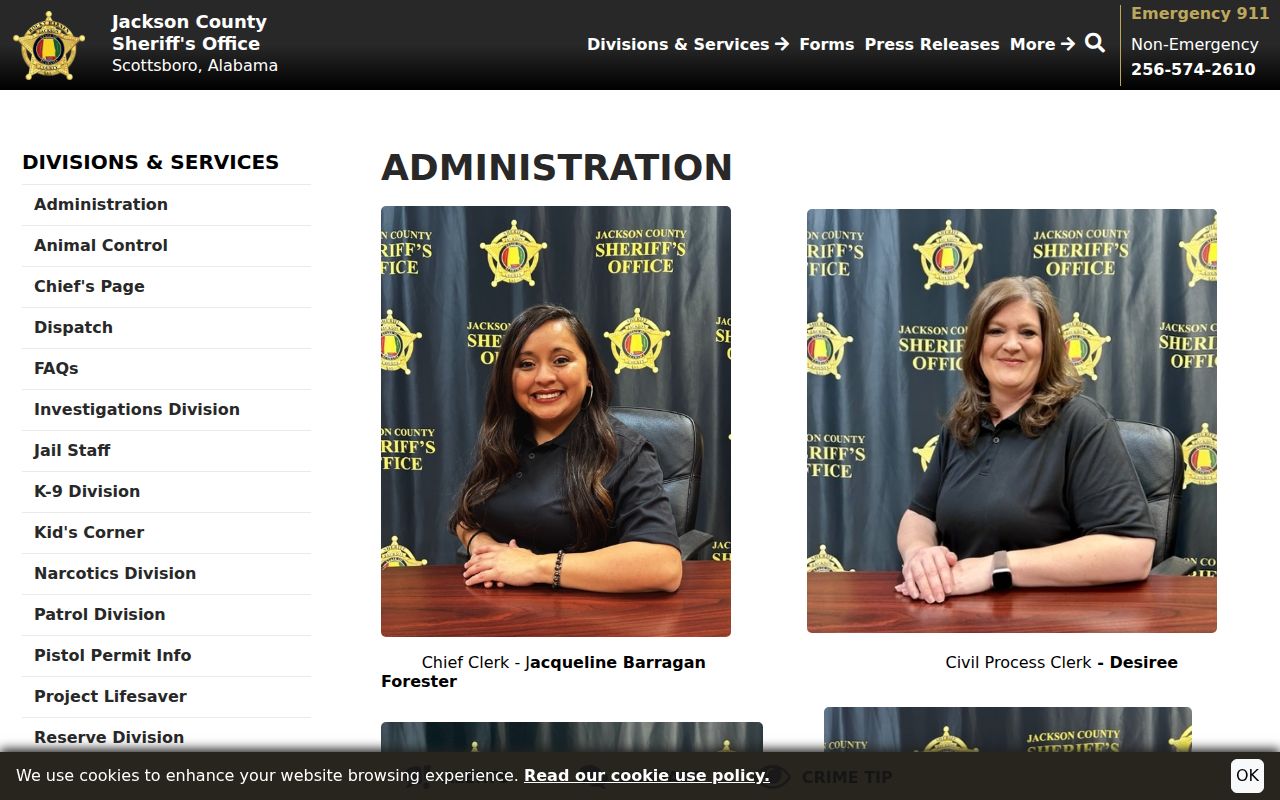
The administrative page confirms the court-to-sheriff service sequence in Jackson County. It is not a public arrest-warrant roster.
Jackson County Arrest Warrant Flow
The local sequence is easier to understand when issuance and service stay separate. A misdemeanor outside city limits may follow this line: incident report → sworn deposition → magistrate probable-cause review → arrest warrant or summons → law-enforcement service → return to the clerk. A felony generally starts with investigation before the probable-cause review.
The Sheriff receives and serves process but never replaces the issuing court. The Circuit Clerk maintains Circuit and District records yet cannot give legal advice. The jail answers custody and bond questions. A city court runs its own municipal process. Calling the right Jackson County office saves you from asking jail staff to recall a warrant or the clerk to judge probable cause.
Note: Jackson County has no separate justice-of-the-peace warrant system, so Texas-style court and capias assumptions do not fit this process.
Comparing Arrest, Summons, and Bench Warrants
Not every Jackson County court order works the same way. Rule 3.1 permits a summons instead. That option needs three things: the person not already in custody, a bailable offense, and no reason for the court to require arrest. Ignore the summons, and a writ of arrest can follow. A bench warrant, by contrast, answers a missed court duty rather than a fresh probable-cause call on a new accusation.
| Feature | Arrest Warrant | Summons | Bench Warrant |
|---|---|---|---|
| Command | Arrest and bring the person before a judge | Appear without initial custody | Take the person before the court after noncompliance |
| Typical basis | Probable cause for an offense | A charge suitable for appearance | Missed setting, nonpayment, or failure to comply |
| Issuer | Judge or magistrate | Judge or magistrate under Rule 3.1 | The court handling the pending matter |
| Response | Confirm, consult counsel, arrange lawful surrender or bond | Appear as directed | Ask the issuing court about appearance or recall |
Missed a court date? The Jackson County bench warrant search walks through the separate city and county court routes.
Jackson County Arrest Warrant Release Terms
Rule 3.2 lets an arrest warrant carry release terms. Those can be personal recognizance, an appearance bond, or a stated security amount. The Jackson County Sheriff's official bond FAQ lays out four practical routes: own recognizance, a private bonding company, property bond, and cash bond. Which route applies depends on the case.
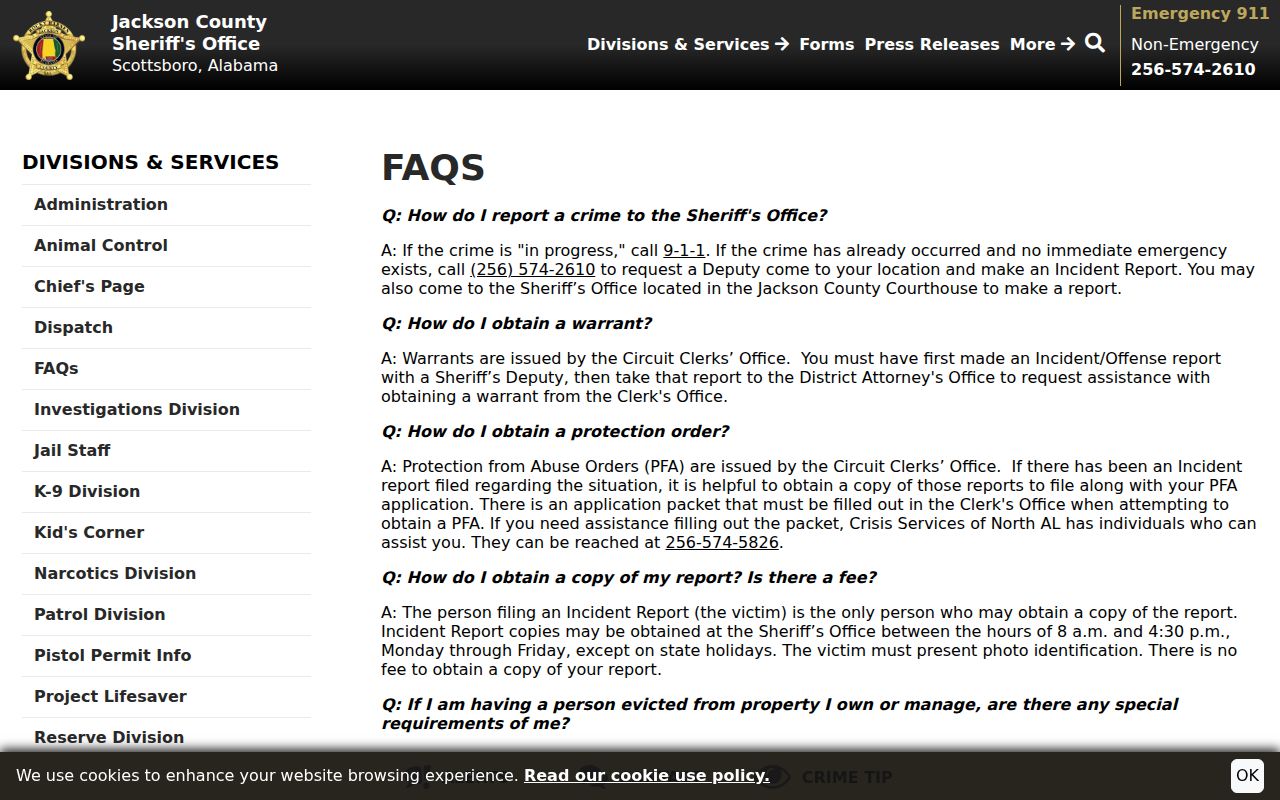
Cash bond cannot be paid at the jail. The FAQ sends that payment to the Jackson County Circuit Clerk or to the municipality owed instead, since warrant applications and bond questions move through different offices and steps. For bond questions, the Jackson County jail answers at 256-574-1884, and staff there can confirm the current bond type. Alabama's Rule 7.2 schedules set a general framework. They are not a quote for any particular Jackson County arrest warrant, and no exact local bond amount is published. When the warrant terms allow release, Rule 4.3 permits it on the stated appearance bond, personal recognizance, or signature. That keeps a person out of custody while the case moves forward. If terms are missing or cannot be met, the rule requires the person to be brought before a judge without undue delay. The outside limit is 72 hours. Only the issuing court can settle what release requires.
Search Warrants Are Separate
An arrest warrant and a search warrant do different jobs. One puts a person in custody. The other allows a search of a place, property, or person for evidence, under a separate legal process. Alabama Rule of Criminal Procedure 3.9 also covers confidential-informant protection in search-warrant proceedings. Keep the two separate. That distinction matters. A public notice about a law-enforcement search is not proof of a personal Jackson County arrest warrant, and an arrest case does not open every search-related affidavit to the public. For arrest status in Jackson County, the issuing court and its official confirmation channels remain the right focus.
If There's an Arrest Warrant for You
Call before you show up anywhere. The Jackson County Warrant Magistrate and Circuit Clerk share 256-574-9320, the Sheriff answers at 256-574-2610, and the jail handles bond questions at 256-574-1884. Ask where the person should report: court, the Sheriff, the jail, or a municipal court. Ask what ID to bring. Also confirm whether release terms are already set.
- Gather government photo ID, notices, and any case or citation number.
- Consult a lawyer about the warrant, possible surrender, and the correct court.
- Confirm personal status through the Jackson County in-person route.
- Ask whether voluntary surrender and a specific bond route are available.
- Use the issuing court for any motion to recall or quash the warrant.
Important: Arrange the response through counsel and official offices before travel; a suspected active arrest warrant can lead to immediate custody.
A phone call or letter will not recall a warrant. Alabama law includes a recall and alias-warrant reference, but Jackson County publishes no recall form and lists no local filing fee. The issuing court alone controls that action. No office here runs an amnesty event, surrender app, mail form, fax route, or drop box.